Text Us 24/7
 (617)-523-6320


Learn how our immigration attorneys helped a Somali refugee reopen his deportation case, challenge unlawful detention, and obtain asylum nearly 20 years after arriving in the United States.
For many individuals seeking protection in the United States, the path to asylum can be long and complex. For our client, Selim, it took nearly two decades.
After fleeing the civil war in Somalia as a child, surviving as a refugee in Kenya, and arriving alone in the United States as a teenager, Selim faced years of immigration uncertainty before finally being granted political asylum.
Through a legal strategy that included federal litigation, a successful appeal before the Board of Immigration Appeals (BIA), and years of preparation, our immigration attorneys succeeded in having his case reopened and ultimately secured the protection he deserved under U.S. immigration law.
Fleeing the Civil War in Somalia
Selim was only five years old when the civil war in Somalia destroyed his family’s stability and changed his life forever.
The armed conflict resulted in the death of his father and forced his family to flee their home.
Like thousands of Somali refugees, his mother and four sisters first sought refuge in the Dadaab refugee camp in Kenya and later settled in Eastleigh, a community near Nairobi with a large Somali refugee population.
Life was extremely difficult for the refugees. Selim had no access to formal education and also lived with a physical disability. As an undocumented refugee, he lived without identification documents, security, or clear prospects for the future.
Arriving in the United States Without Family or Documents
In August 1999, while still a minor, Selim arrived in the United States thanks to his mother’s great efforts.
As is common for many refugees escaping extreme circumstances, he did not possess a passport or personal identity documents.
The traffickers who arranged his journey-maintained control of the documents used to enter the country. Upon arriving in Washington, D.C., he was left alone at a mosque, without family, financial resources, without a record of his entry into the United States or the ability to speak English.
Fortunately, members of his religious community took him in and provided support as he began building a new life.
Initial Asylum Application and Deportation Proceedings
With the help of his religious community, which provided him with a place to live, Selim filed an application for asylum.
His story was found to be credible and compelling. However, a significant legal issue arose.
Because he could not establish the exact date he entered the United States, the asylum officer concluded that Selim could not prove whether he had filed his application within the statutory deadline.
As a result, his case was referred to Immigration Court by means of a Notice to Appear and deportation proceedings were initiated against him.
The Court Found Him Credible but Did Not Grant Asylum
When Selim finally appeared before an immigration judge, he presented his case honestly and consistently. The judge found his testimony credible and acknowledged the difficult circumstances he had endured.
However, the court concluded that he did not meet the technical requirements for asylum because of the lack of evidence regarding his exact date of entry into the United States.
Selim turned 20 and, although he was not granted asylum, he was allowed to remain in the United States and received employment authorization.
For the first time in his life, Selim had an official document, a Social Security number, and an opportunity to build a future or at least that was what he thought.
Building a Life in the United States
Rather than giving up, Selim made the most of the opportunities available to him. He learned English, continued his education, and eventually earned a college degree.
He secured employment as a professional researcher, started a family, and built a stable life with his wife and children.
For years, he believed he had finally found the security he had been seeking since childhood.
A Shocking Immigration Detention Years Later
Nearly eight years after his immigration hearing, immigration officers arrived at his home and forcibly took him into custody under a court order stating that he had been ordered deported.
Although he was later released and allowed to return to his family, authorities placed an electronic ankle monitor on him and kept him under continuous supervision.
In reality, Selim was not free and the threat of deportation had returned.
FitzGerald Law Company Discovers a Critical Error
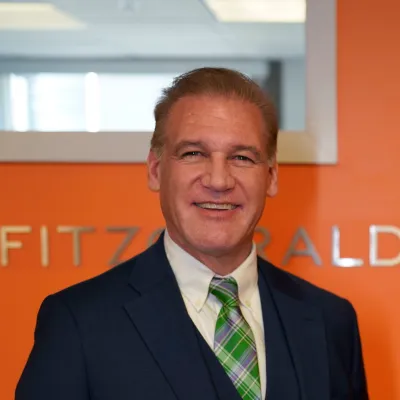
Selim was referred for a friend to FitzGerald Law Company for legal assistance. After carefully reviewing the record, attorney Desmond FitzGerald discovered a fundamental problem.
The alleged deportation order had never been signed by the immigration judge.
As a result, the legal basis used to justify the government’s actions was defective.
Federal Lawsuit Challenging Unlawful Detention
To protect Selim’s rights, attorney FitzGerald filed a Petition for Writ of Habeas Corpus in Federal Court.
This legal remedy allows individuals to challenge unlawful detention.
Although the government argued that Selim was not detained because he had been physically released, attorney Desmond FitzGerald maintained that mandatory electronic monitoring constituted a significant restriction on his liberty and therefore this was a form of detention.
The federal action allowed us to challenge the legality of the measures imposed by immigration authorities.
Successful Appeal Before the Board of Immigration Appeals (BIA)
At the same time, our attorneys filed an appeal with the Board of Immigration Appeals (BIA) to reopen Selim’s case. The appeal demonstrated that Selim was still a minor when he had originally filed his asylum application.
Under the law applicable at that time, minors were not required to prove their exact date of entry in order to satisfy the timely filing requirement.
The BIA agreed. The BIA tribunal ordered the case reopen and remanded it to Immigration Court in Tennessee for proper reconsideration of the asylum application.
Shortly thereafter, the electronic ankle monitor was removed, and Selim was able to feel free again.
The Final Challenge: Proving His Age Without Official Documents
Despite the reopening of the case, a significant challenge remained. Selim had no birth certificate, school records, or official documents establishing his age which was fundamental to their application.
It was necessary to prove to the immigration court that he had submitted his asylum application before turning eighteen and a half, in order to qualify for asylum without needing evidence of his entry into the United States.
Department of Homeland Security attorneys wanted Selim to obtain verifiable proof of his age.
Unfortunately, this was not possible for a Somali refugee, as his community had been destroyed by war when he was a child.
Attorney FitzGerald determined that, because Selim’s application had been submitted prior to the enactment of the REAL ID Act of 2005, he could base his claim on his testimony alone, without supporting documentation, provided his testimony was credible.
Years of Preparation for the Final Hearing
Over the following years, Selim prepared for his hearing with the help of the lawyers and the team at FitzGerald Law Company. There were a series of hearings in Tennessee immigration court, and Selim responsibly took time away from work and his family to appear in court on the required dates.
Despite the challenges, he never stopped fighting for the protection he had sought since arriving in the United States while continuing to work and support his family
After 20 Years, Justice Finally Arrived
Finally, in the spring of 2019, nearly twenty years after arriving in the United States and filing his asylum application, Selim had the opportunity to have his case properly evaluated under the applicable law.
His testimony was found not only credible but also compelling. The Immigration Court and government attorneys agreed with the legal arguments and the evaluation of the law presented by our team.
Results Achieved in This Asylum Case
- Reopening of the deportation case
- Removal of the electronic monitor
- Successful BIA appeal
- Asylum application reconsidered
- Political asylum granted
After decades of uncertainty, Selim finally obtained the legal protection he had sought since he was a child refugee.
Experienced Immigration Lawyers for Complex Asylum and Deportation Cases
The immigration attorneys at FitzGerald Law Company have extensive experience representing individuals in complex immigration matters involving:
- Asylum applications
- BIA appeals
- Motions to reopen immigration cases
- Deportation defense
- Federal immigration litigation
- Immigration Court proceedings
If you or a family member is facing an immigration issue, our team can evaluate your legal options and help you develop an effective strategy for your case.
Call at (617) 523-6320 to schedule an initial consultation with one of our immigration attorneys.